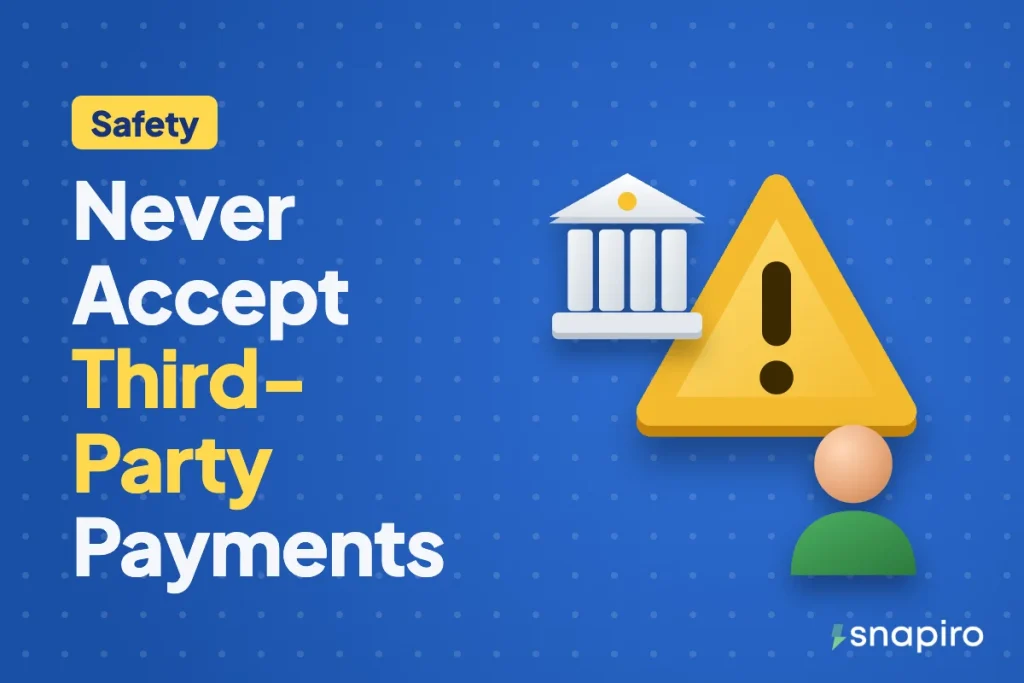
A third-party payment is when the naira for your crypto comes from an account that doesn’t belong to the person you’re trading with. Never accept one, however good the excuse or the rate.
Even when the money is real, it may belong to a fraud victim. When that victim reports the transfer, the trail leads to your bank account, not the buyer’s, and you can lose both the crypto and the naira.
This is general information for people selling crypto in Nigeria, not legal advice. It covers how the triangle scam works, the excuses buyers use, how to check a payment before you release, and what to do if one is already in your account.
What counts as a third-party payment
Your buyer’s profile says Chinedu Okafor. The credit in your bank app says it came from Blessing Adeyemi, or from a business name, or from a POS agent’s account. That’s a third-party payment. The amount can be exactly right and it’s still the wrong money.
Many P2P marketplaces forbid these payments in their rules. Binance’s P2P policy, for example, prohibits them and puts the loss on the buyer when a dispute shows one was used. Check the rules of whatever marketplace you use.
How the triangle scam works
Most third-party payments in crypto deals come from a three-person setup. Here’s how it plays out, step by step:
- A scammer advertises something online: a phone, a car part, a rented flat, a “cheap” bag of rice.
- At the same time, the scammer opens a trade with you to get your crypto.
- When the victim is ready to pay for the item, the scammer gives them your account number.
- The victim pays you. You see real money arrive and release the crypto to the scammer.
- The item never arrives. The victim reports the transfer to their bank and the police, and your account details are on the receipt.
The scammer walks away with crypto. The victim lost their money. You’re left with a frozen account and a stranger who believes you robbed them. You may also have to give the money back, which means you lose the crypto too.
The excuses you’ll hear
Buyers rarely say “this is someone else’s money”. They give a reason that sounds normal:
- “My account has a daily limit, so my brother paid for me.”
- “I paid from my company account.”
- “My customer paid you directly to save time.”
- “It’s my wife’s account, same family.”
- “I used a POS agent because my app is down.”
Some of these might be true. You have no way to tell which, and the risk lands on you either way. Treat every one of them the same: refuse.
Why this hurts the seller most
Banks follow the money. When a fraud report comes in, the bank that received the funds is asked to act, and that’s yours. It may place a restriction so nothing can leave the account while it investigates, or hold the specific amount. You then have to show where the money came from and why you received it.
Your crypto has already gone to someone you can’t trace, so the evidence you have is a chat with a stranger. What a restriction looks like, and how to get one lifted, is set out in selling crypto without getting your bank account frozen.
How to check before you release
- Open your bank app, not your SMS. Confirm the money is in your available balance. Alerts and screenshots can be faked.
- Open the transaction details. Most Nigerian bank apps show the sender’s name and bank on the credit.
- Compare it with the buyer’s verified name on the marketplace, not a name they type in chat.
- If it doesn’t match exactly, don’t release. Tell the buyer in the marketplace chat that you only accept payment from their own account, and follow the marketplace’s process.
If a third-party payment is already in your account
- Don’t release the crypto. This is the step that turns a problem into a loss.
- Don’t send the money to a new account the buyer names. Refunds only go back to the account that paid you, and only through the marketplace’s dispute or appeal process so there’s a record.
- Keep everything. Screenshot the chat, the trade ID and the credit details in your bank app.
- Contact the marketplace’s support from inside the platform, not through a number someone sends you. Fake “support” accounts target exactly this moment; here’s how to tell a real company account from a fake.
- Tell your bank early if you suspect fraud. Explaining first is far better than explaining after a restriction.
The simplest fix: don’t take naira from strangers
Third-party payments only exist because a stranger is paying you. When you sell through an app instead, no stranger is paying you, and the naira lands in your own wallet. Our P2P vs selling to a platform comparison covers the wider trade-off.
On Snapiro, you send USDT, BTC, ETH, SOL or another supported coin to your own deposit address in the app, tap Sell Crypto, and see the naira figure before you confirm with your PIN. The naira lands in your naira wallet straight away. You then withdraw to your bank, and the account must be in your own name and match your verified BVN or NIN. Each withdrawal costs ₦200, as listed on the fees page.
That name-match rule works in your favour. Money only moves between Snapiro and an account in your name, so your bank statement tells a simple story. The bank account name rule explains what to do if your names don’t line up.
Comparing offers? A buyer with a much higher rate who wants to pay from someone else’s account is one of the red flags of an offer that’s too good.
Other things people ask
What if the sender is the buyer’s spouse or relative?
Still refuse. You can’t verify the relationship, and a relative’s account can be used without their knowledge. Ask the buyer to pay from their own account.
Can I refund the money and cancel?
Yes, but only to the account that sent it, and only through the marketplace’s process so the refund is on record. Never “refund” to a different account, which is a common follow-up trick.
Can I sell crypto for someone else and send them the naira?
That creates the same mixed money trail. It’s better for them to sell from their own account. Here’s how to help family sell crypto and set them up properly.
Does Snapiro ever pay me from a person’s account?
No buyer pays you on Snapiro. You sell through the app and the naira goes to your naira wallet first. If anyone claiming to be Snapiro asks you to receive or forward money, or asks for your PIN, it’s a scam. Here’s how to spot them.
Keep strangers out of it. Check the rate on the USDT page and sell through the Snapiro app.