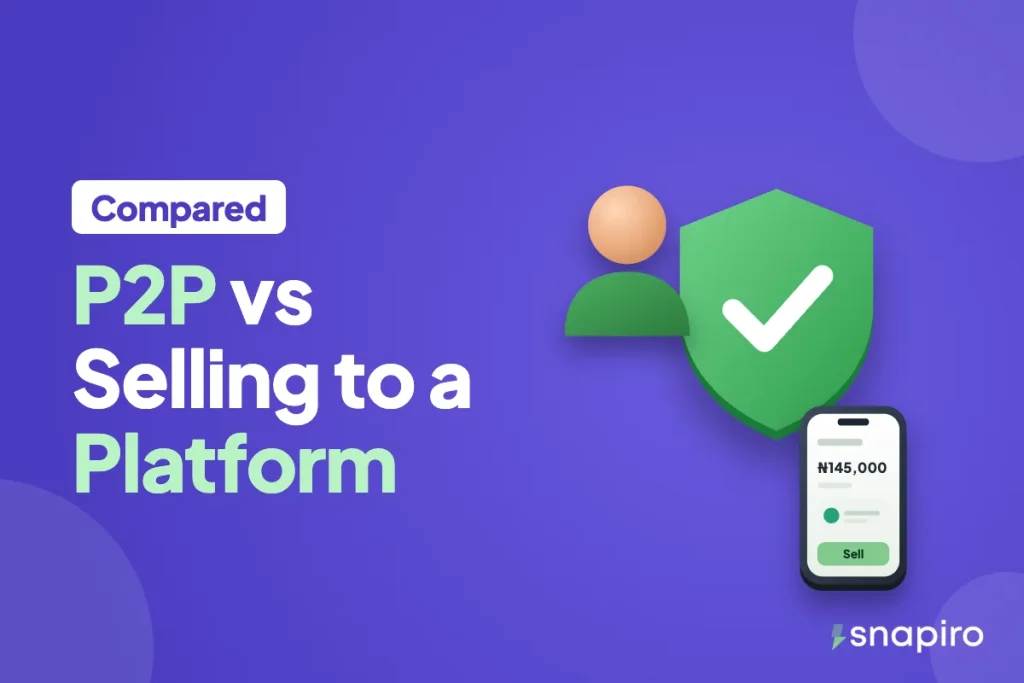
Selling through an app is safer for most Nigerians because there’s no stranger on the other side. On P2P you hand your coins to a buyer and trust that their naira is real, cleared and clean.
When you sell through an app, there is no stranger on the other side of the trade. You see the naira amount before you confirm, and the money comes from the platform rather than from someone’s account you know nothing about.
P2P isn’t a scam by design, and plenty of people use it without trouble. But most of the ways sellers lose money in Nigeria happen on P2P, so it helps to know exactly where the risk sits.
How each one works
P2P (peer to peer): you post or accept an offer on a marketplace. The buyer sends naira from their bank to yours, you confirm it has arrived, then you release the crypto held in escrow. The marketplace sets the rules and handles disputes, but the naira moves directly between two private bank accounts.
Selling through an app: you deposit crypto to an address the app gives you, then sell it at a rate it shows you. On Snapiro, the naira goes into your naira wallet the moment you confirm with your PIN, and you withdraw to your own bank when you’re ready. Every step is set out in how to sell USDT for naira.
| P2P marketplace | Selling to a platform | |
|---|---|---|
| Who pays you | A stranger’s bank account | The platform |
| When you get naira | Whenever the buyer pays | When you confirm the sale |
| Fake alert risk | Real | None, the credit is in your app balance |
| Reversal or “fraud” claim risk | Real | None from a third party |
| Rate | Set by each offer, can be higher | Shown by the platform before you confirm |
| Time spent | Chatting, checking, waiting | A few taps |
The P2P risks that actually cost sellers money
Fake payment alerts and screenshots
The oldest trick. A buyer sends a doctored screenshot or a fake SMS that looks like your bank’s credit alert, then pushes you to release quickly. If you release before checking your actual balance in your banking app, the coins are gone. An SMS is not proof; only the balance in your bank app is.
Payment reversals and “unauthorised transaction” claims
Here the money really does arrive. After you release, the buyer goes to their bank and claims the transfer was unauthorised. The bank can then freeze or pull back the funds from your account while it investigates, and you’ve already lost the crypto.
Third-party and stolen money
This one hurts honest sellers most. A fraudster scams someone else, then uses the victim’s money to buy your crypto. You did nothing wrong, but the victim reports the transfer, the trail leads to your account, and your bank can freeze it. Nigerian tech press has reported P2P traders having accounts flagged and frozen over payments from accounts that weren’t the buyer’s own, which is why many experienced traders refuse payments from any name that doesn’t match the buyer’s profile.
Being talked off the platform
“Let’s finish this on WhatsApp, I’ll give you a better rate.” Once you leave the marketplace, there’s no escrow and no dispute process. Anything that happens next is between you and a stranger.
Where platforms carry their own risks
Selling to a platform removes the stranger, but you’re now trusting the platform. That’s a different question, and you should ask it properly:
- Is it real? Check that the app is on Google Play and the App Store, that support answers, and that the company explains how it protects your money. Snapiro’s answers are on is Snapiro legit and the security page.
- Is it the real one? Copycat websites, fake WhatsApp “agents” and cloned apps exist for every popular platform. Download from the official store and never send coins to an address someone gives you in a chat.
- Do you see the full cost? A good platform shows the naira you’ll get before you confirm and lists every charge. Snapiro has no separate selling fee; the margin is in the rate, and withdrawals cost ₦200 each, as listed on the fees page.
- Your own mistakes. Sending on the wrong network can lose coins on any platform. One rule prevents it, and TRC20 vs BEP20 vs ERC20 sets it out.
What about the rate?
P2P offers sometimes show a higher naira rate. Before you chase it, count what you’re paying for it: time spent chatting and waiting, the chance of a reversal, and the chance of a frozen account that can take weeks to sort out. A few naira more per dollar doesn’t cover any of those.
Compare the naira that reaches your bank after every fee, not the headline number. You can check Snapiro’s current figure any time on the crypto to naira calculator without logging in.
If you still use P2P, protect yourself
- Release only after the money shows in your bank app balance, never on an SMS, email or screenshot.
- Accept payment only from an account in the buyer’s verified name. Refuse third-party payments, however good the excuse.
- Keep all chat and payment proof inside the marketplace so a dispute has evidence.
- Use a bank account you can afford to have frozen for a while, not the one your salary and rent go through.
- Start small with any new buyer, however good their completion record looks.
Selling on Snapiro instead
You deposit to your own address in the app (there’s no minimum deposit), sell at the rate on screen, and the naira is in your naira wallet straight away. Withdrawals go to any bank or wallet on NIBSS in your own name and are sent within 60 seconds of your request, with a ₦1,000 minimum. No buyer can reverse a payment to you, because no buyer ever pays you.
You can deposit without verifying. A verified BVN or NIN is needed to sell, add your bank account and withdraw, and the account name must match your verified name. For sales of $20,000 or more, the high volume desk confirms the rate before you send.
Whatever you use, no real support team will ask for your PIN or password. Here’s how to spot people pretending to be support.
Frequently asked questions
Is P2P trading illegal in Nigeria?
Nigeria’s crypto rules have changed several times in recent years, and marketplaces have changed what they offer in response. Binance, for example, removed naira from its P2P market in February 2024. This is general information, not legal advice: check the marketplace’s own terms and the Securities and Exchange Commission (SEC) Nigeria’s current guidance.
Can a P2P buyer reverse a transfer after I release?
They can’t undo a bank transfer on their own, but they can report it to their bank as fraud. That can lead to your account being frozen or the funds being held while the bank investigates.
Is the escrow on P2P enough protection?
Escrow protects the buyer’s crypto until you release it. It does nothing about fake alerts you believe, or about stolen money that has already reached your account.
Skip the stranger: get the Snapiro app and sell straight from your own wallet.