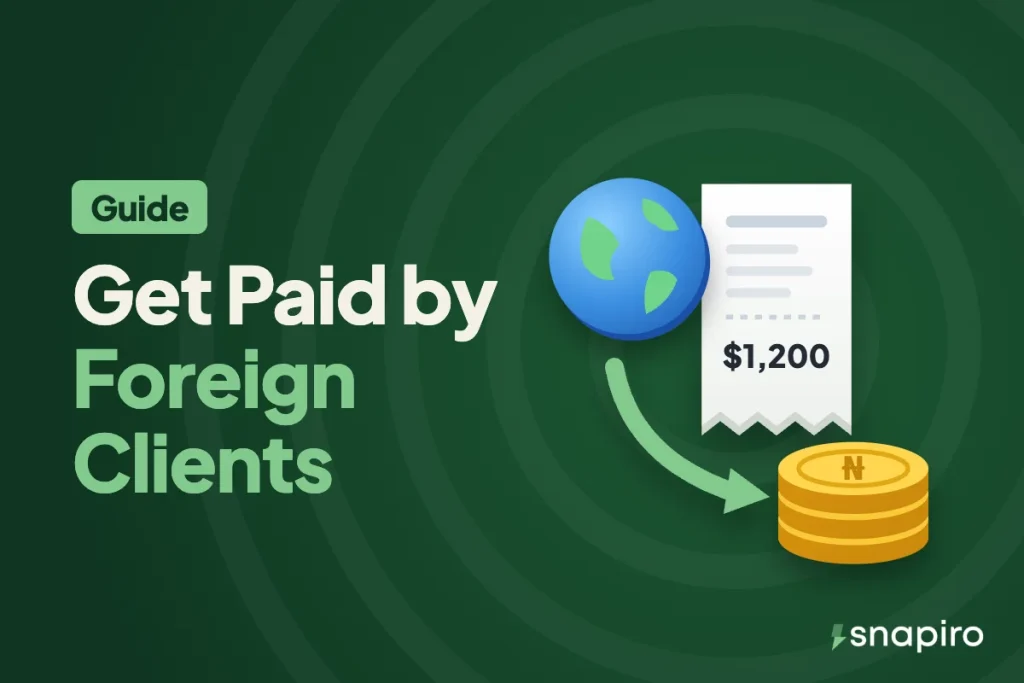
A Nigerian freelancer working with foreign clients usually gets paid one of four ways: through a marketplace like Upwork or Fiverr, through Payoneer, by wire to a dollar (domiciliary) account, or in a stablecoin such as USDT.
Whichever route you use, a clear invoice with agreed payment terms is what gets you paid on time, and in full. Most late or short payments trace back to terms nobody wrote down.
This guide covers each payment route, what belongs on an invoice, the terms to agree before you start any work, and the scams aimed at Nigerian freelancers who work with overseas clients.
The main ways foreign clients pay Nigerian freelancers
| Route | How it works | Best for |
|---|---|---|
| Marketplace (Upwork, Fiverr) | The platform collects from the client and pays you out | Clients you met on that platform |
| Payoneer | The client pays into your Payoneer account; you withdraw to a Nigerian bank | Direct clients who pay by card or bank transfer |
| Wire to a domiciliary account | The client’s bank sends dollars to your Nigerian dollar account | Larger, less frequent payments |
| USDT | The client sends USDT to your wallet; you sell it for naira | Clients comfortable with crypto |
Marketplaces
If the client found you on Upwork or Fiverr, the money must go through that platform. Both have rules against moving those clients off-platform to avoid fees, and breaking them can cost you your account. We’ve covered how to receive payment from Upwork in Nigeria and how to withdraw from Fiverr to a Nigerian bank in separate guides.
Payoneer
Payoneer is popular with direct clients because it gives you a way to receive dollars without the client needing to understand Nigerian banking. Depending on your account, you can share receiving details or send a payment request. You pay Payoneer’s fees and its conversion margin when you withdraw to naira. Fees change, so check them in your account before quoting a client.
Wire to a domiciliary account
Your bank gives you the details the client’s bank needs: your account name and number, the bank’s name and address, and its SWIFT code. Many banks also use an intermediary (correspondent) bank for dollar wires, and they’ll give you those details too. Ask your bank for its exact incoming-wire instructions in writing, because a missing line can send a payment back. Wires can carry charges on both ends, so agree who pays them.
USDT
Some clients, especially in tech and crypto, prefer to pay in USDT. It arrives in minutes on a network like TRC20, and you hold dollars until you choose to convert. When you’re ready, you can sell the USDT for naira on Snapiro at the rate shown before you confirm, then withdraw to any Nigerian bank for ₦200. Follow the steps for selling USDT for naira the first time.
If you take USDT, put the network on your invoice next to the address. A client who sends on the wrong network can lose the payment, and you’ll be the one chasing it.
What to put on an invoice for a foreign client
An invoice isn’t just a request for money. It’s your record for tax, your evidence if a payment is disputed, and the thing a client’s accounts team needs before they release funds.
- Your details: your full name or business name, address, email and, if you have one, your business registration number.
- The client’s details: their company name, address and the contact person.
- An invoice number: unique and in sequence, for example INV-0042.
- Dates: the issue date and the due date.
- What you did: a line for each piece of work, with hours or units and the rate.
- The total and the currency: write “USD 1,200”, not just “1,200”.
- Payment terms: for example “Due within 14 days”.
- How to pay: exactly one or two methods, with every detail the client needs. For USDT, the address and the network.
- A purchase order or reference if the client gave you one. Large companies often won’t pay without it.
Save each invoice as a PDF, keep the numbering going across clients, and file a copy with the payment proof. Those records are what you’ll use to work out your tax.
Payment terms to agree before you start
Most late payments come from vague terms. Put these in writing, in an email or a short contract, before work begins:
- The price and currency, and whether it’s per hour, per project or per month.
- A deposit, such as half upfront for a new client, with the balance on delivery.
- Milestones for longer projects, so you’re never owed for months of work.
- The due date, for example 7 or 14 days after the invoice.
- Who pays transfer fees, especially on wires.
- What happens if payment is late, such as pausing work until it’s settled.
- How many revisions are included before extra work is billed.
One simple rule: quote in the currency you want to be paid in, and don’t let a client convert it for you.
Scams that target freelancers with foreign clients
The overpayment trick. A “client” sends more than the invoice, then asks you to refund the difference. The original payment later bounces or is reversed, and your refund is gone. Never refund an overpayment until the money has fully cleared, and even then, be suspicious.
Fake payment screenshots. A screenshot isn’t money. Wait until the funds show in your own account.
“Pay to start” jobs. A client who asks you to pay for software, training or a “registration fee” before work begins isn’t a client.
Third-party payments. Money sent by someone other than your client, from an account you can’t link to them, can bring trouble later. Ask that payment comes from the client or their company.
Our help article on how to identify scammers covers more warning signs.
Tax on income from foreign clients
If you live in Nigeria, payment from foreign clients is income. Under the Nigeria Tax Act 2025, which applies from 1 January 2026, the first ₦800,000 of taxable income a year is taxed at 0%, and the rate rises in bands from 15% to 25%. The bands and reliefs are in what the Nigeria Tax Act changed, and you can estimate your own figure on the personal income tax calculator. This is general information; speak to a tax professional about your situation.
Questions freelancers ask
Should I invoice in dollars or naira?
If the client is abroad, invoicing in dollars is usual and saves them the conversion. Write the currency on every invoice.
Can a foreign client pay into my Nigerian naira account?
Some services convert and pay into naira accounts, but you lose control of the exchange rate. Compare the naira you actually receive, not the headline rate.
Is it safe to accept USDT from a client?
It can be, if you agree the network, give the address in writing and wait for the transfer to confirm before you deliver final files. Check the naira value on the rate calculator before you convert.
What invoice software should I use?
Any tool that produces numbered PDF invoices works, including a spreadsheet template. Consistency matters more than the app.
If your clients pay in USDT, get the Snapiro app to sell it for naira and withdraw to your bank.