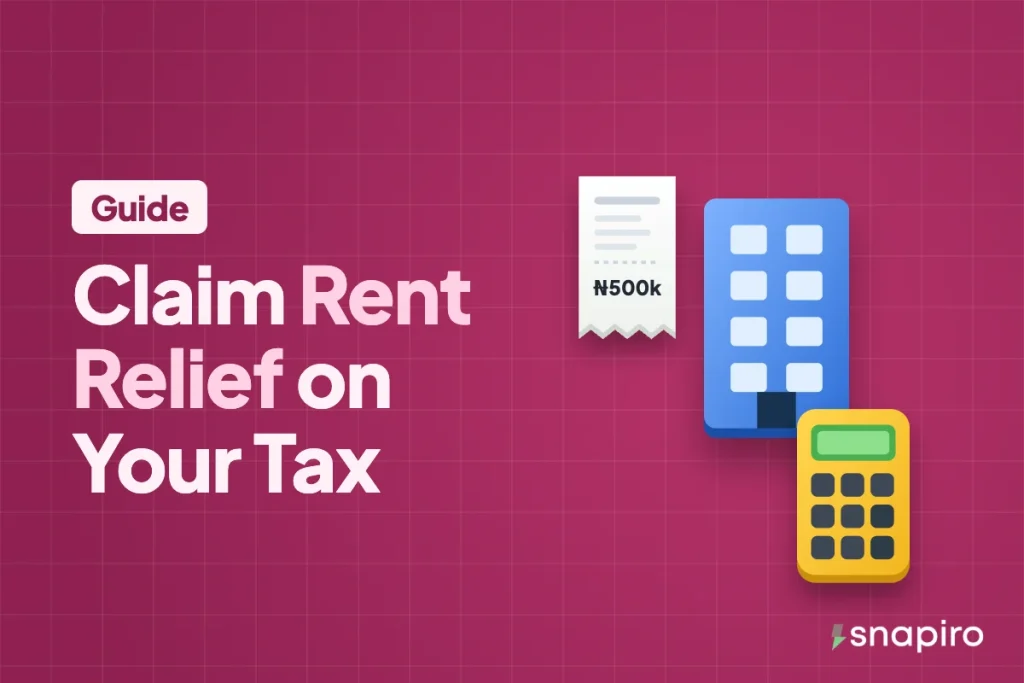
If you rent the place you live in, you can take 20% of the rent you pay in a year off your taxable income, up to a maximum of ₦500,000. That’s rent relief.
Since 1 January 2026 it’s the main personal relief left, after the Consolidated Relief Allowance (CRA) was scrapped. It isn’t automatic, though. You have to declare your rent and be ready to prove it.
Here’s who qualifies, how much it saves you, and how to claim it as an employee or as a self-employed person in Nigeria. It’s general information, not personal tax advice for your situation.
What replaced the CRA
Under the old Personal Income Tax Act, everyone got the CRA: ₦200,000 or 1% of gross income, whichever was higher, plus 20% of gross income. Renters, homeowners and people living with family all got it.
The Nigeria Tax Act 2025 abolished it. In its place, section 30 allows a rent relief of 20% of annual rent paid, capped at ₦500,000, as long as you accurately declare the rent you paid and any other information the tax authority asks for. To balance the loss of the CRA, the first ₦800,000 of taxable income is now taxed at 0%.
Who can claim rent relief
- Tenants. You must actually pay rent. Homeowners and people who live rent-free don’t qualify.
- Employees on PAYE, through their employer’s payroll.
- Self-employed people, freelancers and traders who file their own returns with their state internal revenue service.
If you share a flat, each person can claim on the share of the rent they actually pay. The relief is for rent on your home. Rent on a shop or office is a business expense, which is handled differently on a business return.
How much relief you get
Take 20% of the rent you paid for the year. If the answer is more than ₦500,000, you get ₦500,000. The cap kicks in at ₦2,500,000 rent a year.
| Annual rent | 20% of rent | Relief you get |
|---|---|---|
| ₦600,000 | ₦120,000 | ₦120,000 |
| ₦1,500,000 | ₦300,000 | ₦300,000 |
| ₦2,500,000 | ₦500,000 | ₦500,000 |
| ₦4,000,000 | ₦800,000 | ₦500,000 (capped) |
Relief is not cash back. It lowers your taxable income, so the tax you save is the relief multiplied by your top tax rate: 15% or 18% for most salary earners. How tax bands work explains why.
Two worked examples
These are examples only, assuming all pay is basic, housing and transport, with 8% pension and no other deductions.
₦200,000 a month, rent ₦600,000 a year
- Gross: ₦2,400,000. Pension: ₦192,000.
- Without rent relief: taxable income ₦2,208,000, tax ₦211,200 a year (15% of the ₦1,408,000 above ₦800,000).
- With ₦120,000 rent relief: taxable income ₦2,088,000, tax ₦193,200.
- Saving: ₦18,000 a year, ₦1,500 a month.
₦500,000 a month, rent ₦1,500,000 a year
- Gross: ₦6,000,000. Pension: ₦480,000.
- Without rent relief: taxable income ₦5,520,000, tax ₦783,600.
- With ₦300,000 rent relief: taxable income ₦5,220,000, tax ₦729,600.
- Saving: ₦54,000 a year, ₦4,500 a month.
Run your own salary and rent through the PAYE calculator. It has a rent field and shows the tax in each band.
How to claim it as an employee
- Ask HR or payroll for their rent declaration form. Many employers have one for the new rules; if yours doesn’t, a written declaration works as a start.
- Declare the rent you pay for the year and the period it covers.
- Attach proof: your tenancy agreement and rent receipts. Employers commonly ask for the landlord’s or agent’s name, phone number and the property address too.
- Check your next payslip. Your PAYE should drop by roughly the relief times your top rate, spread over the remaining months.
If you missed it this year, you can still claim on your annual return, which the new administration law expects employees to file on top of PAYE. See how to file tax returns.
How to claim it if you’re self-employed
Your personal income tax goes to the internal revenue service of the state where you live, not the Nigeria Revenue Service. Declare your rent on your annual return and keep the agreement and receipts, because the law lets the tax authority ask for documents and refuse the deduction if they’re missing or inadequate. You’ll need a tax ID to file.
Freelancers paid in dollars or USDT work out tax on their naira income the same way. If you sell USDT for naira on Snapiro, every completed sale sits under Activity with its date and naira amount, which makes your income records easier to put together.
Proof that holds up
- A signed tenancy agreement showing the rent and period.
- Receipts from the landlord or agent for each payment.
- Bank transfer records. Paying rent by transfer, rather than cash, leaves a trail that’s easy to show.
Don’t inflate the figure. The law requires an accurate declaration, and the tax authority can refuse a claim it can’t verify.
Frequently asked questions
I paid two years’ rent upfront. Can I claim it all this year?
The law speaks of annual rent, and advisers generally read it as only the part covering the tax year. So ₦3 million for two years counts as ₦1.5 million a year. Confirm with your employer or state revenue service.
I own my house. Do I get anything in place of the CRA?
Not rent relief. You still get the 0% band on the first ₦800,000, and if you took a loan to build the house you live in, the interest on that loan is deductible.
Can I claim rent I pay for my parents?
The relief is meant for the rent on the home you live in. For anything outside that, ask your state revenue service before you claim.
Is rent relief the only deduction left?
No. Pension, National Housing Fund, health insurance and life insurance premiums are still deductible. How to calculate PAYE shows the full order.
Rent relief replaced the CRA, so check that your payslip reflects it. Other guides to the new rules are in the tax in Nigeria section.